
How to Choose the Right Camping Stretcher for a Good Night's Sleep
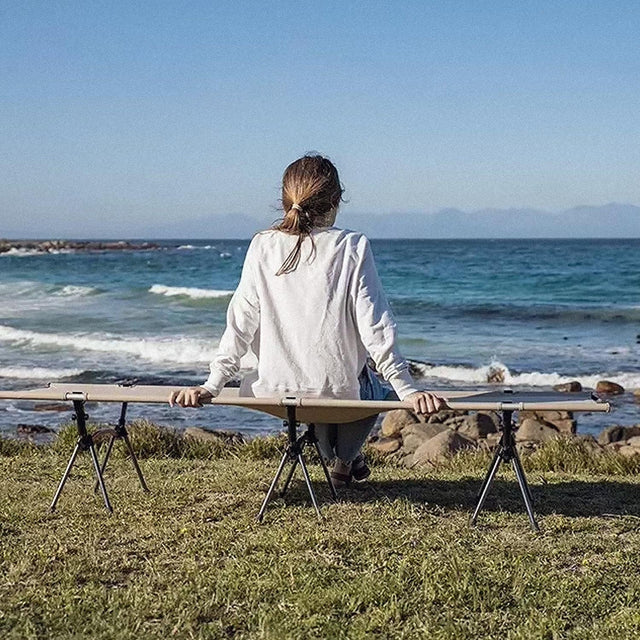
Choose a camping stretcher by how high it sits off the ground and how much it weighs, then add a topper or a pad for warmth. Height decides how easy it is to sit up and stand, and how much headroom the tent leaves you. Weight and packed size matter most at a hike-in site, where you carry everything yourself. The stretchers covered below range from 15 cm to 38 cm high and from 2.2 kg to 3.19 kg.
Warmth is the part buyers tend to miss. Cold air moves freely under the deck, which means a bare stretcher often sleeps colder than people expect.
Stretcher or Mattress: What Changes When You Sleep Off the Ground
A stretcher lifts you clear of damp soil and uneven ground, the two things that ruin most nights in a tent. A mattress stays on the ground and relies on its own insulation to hold the cold back. That difference decides which of the two suits your trips.
Getting up is easier too. You sit on the edge of a stretcher, pull your boots on and stand, with no crawling out of a low sleeping bag at dawn. For anyone with stiff knees or a sore back, that is often the deciding factor.
The trade-off is warmth. A self-inflating pad lies on the ground and insulates by itself, while a stretcher needs something on top to match it. Plan for that layer when you set your budget.
Is a camping stretcher better than a mattress?
It depends on the trip, and weight rarely settles it. The XJC05 stretcher weighs about 2.2 kg, slightly less than the D04 self-inflating pad at about 2.3 kg in our guide to camping mattresses. The pad insulates by itself, though, while the stretcher needs a topper or pad on top. Choose the stretcher for sitting height and ground clearance, and the pad for the simplest warm setup.
Are camping stretchers comfortable?
Yes, once the deck is tight. A slack deck sags under your hips and leaves your shoulders pressing on the frame. The XJC04 has a lever locking system that tensions the deck after you set it up, so you can retension it whenever it feels slack. A bare deck still feels firm, which is why most people add a topper.
How to Choose a Camping Stretcher: The Specs That Decide It
Four specs decide how well a stretcher suits you: weight capacity, frame height, packed size and carry weight. Check them against how you travel before you compare prices, because a stretcher that suits a car boot can be a poor fit for a hike-in site.
Carry weight and packed size come first. The XJC05 and XJC04 weigh about 2.2 kg each, and the XJC05 packs shortest at 46 cm long and 16 cm across. The XJC06 weighs 3.19 kg and packs to 55 cm long and 19 cm across, so it takes more room and more carrying.
Frame height deserves its own check. A taller frame is easier to sit on and rise from, while a lower one keeps your head further from the tent roof. The range runs from 15 cm up to 38 cm, so you can choose which trade-off matters more to you.
How much weight can a camping stretcher hold?
All three Naturehike stretchers are rated to 150 kg. Each uses a 7075 aluminium frame, and the XJC05 has a pole wall 1.6 mm thick. That rating covers one adult sleeping alone, so a couple needs two stretchers rather than one shared deck.
What size camping stretcher do I need?
Each Naturehike stretcher is 190 cm long and 65 cm wide. That fits most adults, though a sleeper taller than about 1.85 m will have little length to spare and a broad sleeper who rolls around will feel the edges. Measure yourself from heel to head with a pillow in place before you order. The topper is 190 × 67 cm and fits stretchers up to that size, so it covers the full deck.
The Naturehike Stretcher Range Compared
Naturehike sells three stretchers, and the differences come down to height, weight and how each one is meant to travel.
|
Model |
Price |
Height off ground |
Weight |
Packed size |
Best suited to |
|
XJC05 |
R2,199 |
15 cm |
2.2 kg |
46 × 16 cm |
Lowest price and shortest packed length |
|
XJC04 |
R2,999 |
38 cm |
2.2 kg |
53 × 20 × 20 cm |
Vehicle-based camps |
|
XJC06 |
R2,799 |
38 cm or 18 cm |
3.19 kg |
55 × 19 cm |
Choosing your height on each trip |
The XJC05 is the entry point. At 15 cm it sits lowest, which suits small tents where headroom is tight, and it has the shortest packed length of the three. The XJC04 sits at 38 cm and tensions the deck with its lever locking system. Naturehike positions it for camps you drive to rather than hiking trips, since it travels in a vehicle.
The XJC06 gives you two heights. Fit or remove the leg extensions to switch between 38 cm and 18 cm, depending on the tent. It is also the heaviest of the three at 3.19 kg.
Naturehike covers each one with a one-year warranty against factory defects.
Keeping Warm on a Camping Stretcher
Warmth is the part of a stretcher setup you build yourself. Cold air circulates under the deck, so heat drains away from below even when your sleeping bag is a good one.
How do you keep warm on a camping stretcher?
Start with the topper. These are its specs:
-
Measures 190 × 67 cm
-
Uses 350 gsm synthetic fill
-
Buckles onto the frame, so it stays put when you roll over
-
Weighs about 860 g
-
Packs to 36 cm long and 20 cm across
-
Costs R999
It is a topper and not a sleeping pad, and it offers no insulation on its own.
For nights near freezing, which Highveld winters deliver, lay a sleeping pad on the deck and put the topper over it. Browse the pads collection and pick a thickness for the season. Your bag matters too. Choose one with a comfort rating below the forecast low, since a stretcher leaves the underside of your bag exposed to moving air.
The topper is also machine washable, which helps after a muddy weekend. Weight and price add up once the warm layer is on. An XJC05 with the topper weighs 3.06 kg and costs R3,198. An XJC06 with the topper weighs 4.05 kg and costs R3,798.
Fitting a Stretcher in Your Tent and Your Boot
Work through this checklist before you order:
-
Measure the tent floor. A stretcher is 190 cm long and 65 cm wide, so the floor needs that much clear space before you add room for bags and boots. Two stretchers side by side need 130 cm of width, before you count the gap between them.
-
Measure the roof above your head. A dome tent slopes down toward the sides, so check the height above the spot where your head will rest. A 38 cm frame lifts you 38 cm closer to the roof, and sitting up on the edge adds your seated height on top. In a small dome tent, the XJC05 at 15 cm or the XJC06 at 18 cm leaves far more room above you.
-
Set the stretcher up once at home. The XJC04 has a lever to tension the deck and the XJC06 needs its leg extensions fitted or removed for each height, so a practice run in the garage saves fumbling in the dark at a campsite.
Packed, the three stretchers measure between 46 cm and 55 cm long, which leaves boot space for the rest of your kit. On drive-in sites, such as many SANParks rest camps and campsites in the Cederberg, you carry the stretcher from car to tent and the weight barely matters. A hike-in site changes that, because you carry everything on your back and the XJC04 is not designed for it.
Pick the Stretcher That Matches Your Trips
A family that pitches at a drive-in site every school holiday gains the most from the XJC04, because everyone can sit on the edge to dress and pull on boots. For regular car camping it is the natural fit. Its lever system lets you retension the deck during a long weekend.
For small tents and a lower price, the XJC05 does the job. The XJC06 suits campers who swap between a roomy family tent and a compact one, because the two heights let one stretcher serve both.
Budget settles the rest. Compared with the XJC05, the XJC04 costs R800 more and sits 23 cm higher. The XJC06 costs R600 more than the XJC05 and gives you both heights, which is the better use of the extra money if your tents vary. Whichever you pick, allow for the topper at R999 or a pad on top, since a bare deck feels firm.
The full collection shows all three with current prices. Unused items can be returned within 10 days, and the Pretoria office is open for viewing by prior arrangement.


0 Comments
There are no comments for this article. Be the first one to leave a message!